What Happens When VBS Becomes Intergenerational?
by Rev. Meg Sweeney Cook
When most people hear “Vacation Bible School,” they picture children moving from station to station while adults supervise from the sidelines.
At Grace United Methodist Church in Columbia, South Carolina, we wanted something different. Two years ago, after receiving Messy Church training, I began wondering what would happen if we took the core elements of the Messy Church model—hospitality, creativity, celebration, and shared experiences—and applied them to VBS. Instead of creating a program primarily for children, what if we designed an experience where everyone could participate?
That question led to our first Messy Church VBS, *Joy in the Mess*. Joy in the Mess looked at Messy stories in the Bible (literally messy, prophet Jeremiah in the mud and relationally messy like Jonah’s story). This summer, we completed our second year of Messy Church VBS with *Taste and See*, inspired by Psalm 34:8: “Taste and see that the Lord is good.”
One of my first clues that the model was working came from a volunteer, Mrs. Sandra. She doesn’t have children or grandchildren at Grace, yet she immediately embraced leading a craft station and even modified the activity to make it stronger. She wasn’t simply helping participants complete a project; she had ownership of the ministry itself. Her investment reminded me that intergenerational ministry creates meaningful places for adults to participate, regardless of whether they currently have children in the program.
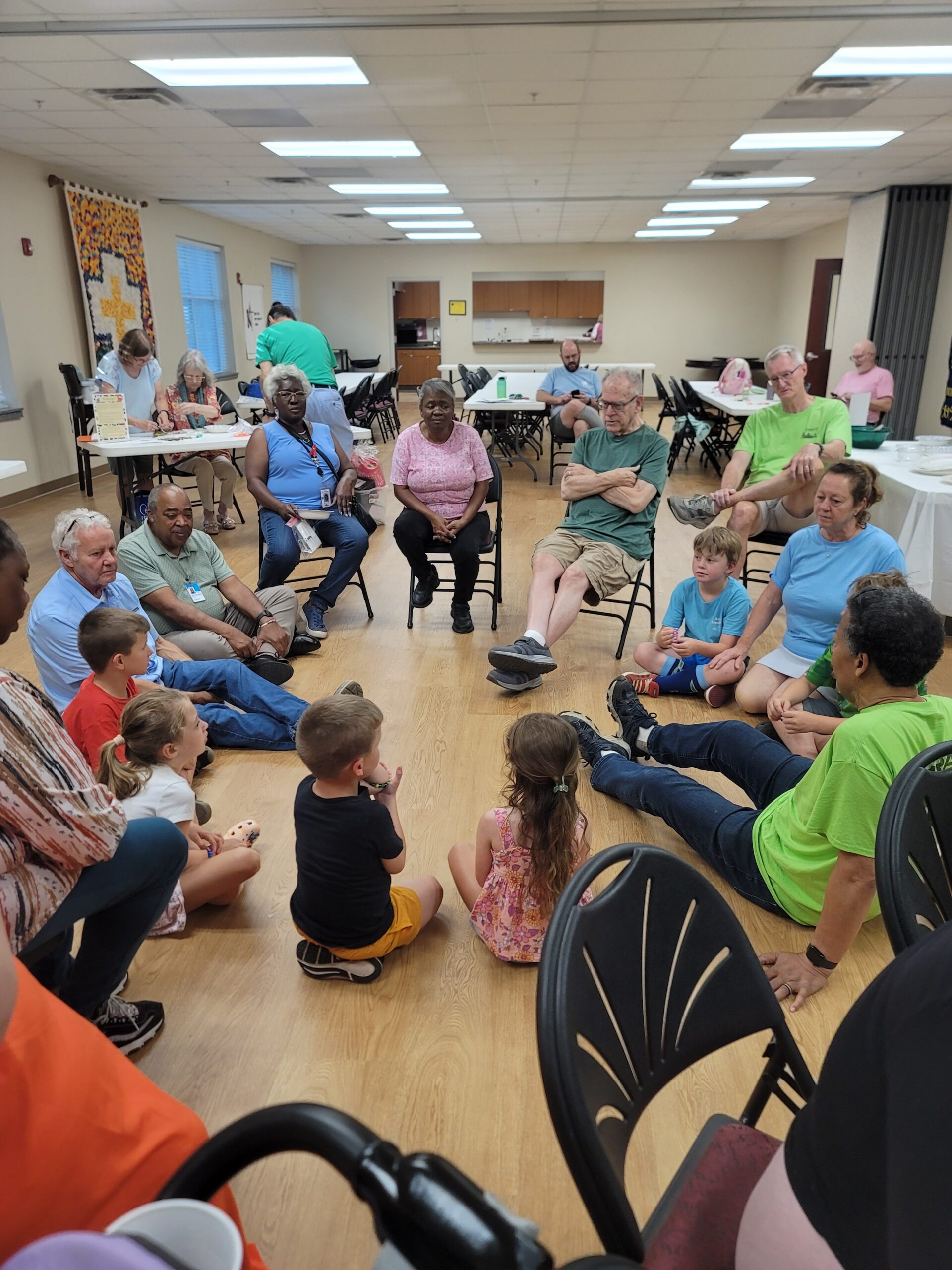
Another clue came as families moved through the stations together. Children proudly shared what they had made—but so did the adults. I found myself overhearing conversations like, “Look what I made!” and “Come see this!” Grandparents, parents, children, and friends weren’t standing on the sidelines watching faith formation happen. They were actively engaged in it together.
That spirit continued into our second year. One of the unexpected gifts of *Taste and See* was the number of church members who attended even though they did not have children or grandchildren participating. They came because they had discovered this wasn’t simply a children’s event. It was a church event.
We also welcomed families who first connected with Grace through a Messy Easter celebration. Seeing them return reminded us that consistency matters. People are more likely to come back when they know what to expect.
One simple addition in year two made a surprising difference: table conversation prompts during the meal. We also switched from round tables to long tables, encouraging participants to interact across families and generations. Before we ever reached the activities, conversations were already forming.
Another lesson we’ve learned is the value of offering a variety of ways to engage. One grandmother told me how much she appreciated that her younger grandchildren and her tweens could all find something that interested them. That’s one of the strengths of the Messy Church model: there are multiple entry points into the biblical story.
In our context, science-based stations have been especially popular. Hands-on experiments consistently spark curiosity and conversation across generations. This year, another favorite was a trust walk, where one blindfolded participant was verbally guided by a partner through simple obstacles. The activity created moments of laughter, vulnerability, and conversations about trust, faith, and relationships.
Alongside crafts and activities, we also offer a discussion station for participants who want to explore the scripture more deeply and a reflection station for prayer, journaling, coloring, or quiet time with God. The self-paced nature of the stations allows people to engage according to their interests, energy, and comfort level. We’ve found this flexibility especially welcoming because there is room for everyone to participate authentically. It’s good for our neurodivergent friends as well!
After two years, I’ve become convinced that intergenerational ministry is more than putting different age groups in the same room. It’s about creating experiences where people genuinely engage with one another—around a table, at a craft station, during a science experiment, or through a shared story. I think this is how the church should be all the time.
The Messy Church model gave us permission to build VBS around the gifts and realities of our congregation. We didn’t abandon VBS. We simply reimagined it. And what we’ve discovered is that when people of all ages learn, create, wonder, worship, and share meals together, the whole church grows.
Rev. Meg Sweeney Cook serves Grace United Methodist Church in Columbia, South Carolina. Holding master’s degrees in Divinity and Christian Education, she is passionate about creating spaces where people of all ages can wonder, learn, and grow in faith together. She writes occasionally at Cultivate Faith, contributes a monthly children’s sermon column to the SC Advocate, and is the author of the children’s books Herbert the Hippo and Herbert the Hippo in the Moment.